
NONPROFIT FILING REQUIREMENTS
Form 990 Filing for Schools
Most private schools, nonprofit charter schools, and preschools file a Form 990-series return every year. Tax990 shows which form your school needs, adds Schedule E, and e-files the return with the IRS.



WHY YOU NEED TO FILE
Do Nonprofit Schools Have to File Form 990?
Yes, in most cases. A 501(c)(3) school reports to the IRS every year on Form 990, 990-EZ, or 990-N. The main exception is a church-affiliated school below college level, which files Form 5578 instead.
Missing a required return three years running ends your
exemption automatically.
WHO NEEDS TO FILE
Schools & Education Groups That Must File 990
A school has a regular faculty, a set curriculum, and enrolled students on site. If it holds 501(c)(3) status
in its own name, it files under its own EIN.
Private & independent schools
File every year. Schedule E certifies your nondiscrimination policy.
Nonprofit charter schools
File if the nonprofit corporation holds its own 501(c)(3). District-run charters generally don't.
Preschools & early learning centers
Nonprofit preschools and early childhood centers count as schools under the IRS definition and follow the same filing and Schedule E rules.
Church-affiliated schools
Below college level and tied to a church or religious order? No Form 990 or 990-EZ. File Form 5578 each year instead.
Colleges & universities
File a 990-series return with Schedule E, religious ones included.
School foundations, PTAs & booster clubs
A foundation, PTA, PTO or booster club with its own EIN is a separate organization and files its own return, even when it raises money for a public school. See PTA filing requirements
FILING REQUIREMENTS
Which 990 Form Does Your School Need?
Your school's size decides the form, not its grade levels or religious affiliation.
Two numbers decide it: gross receipts and total assets.


DUE DATE
When to File 990 for
Your School?
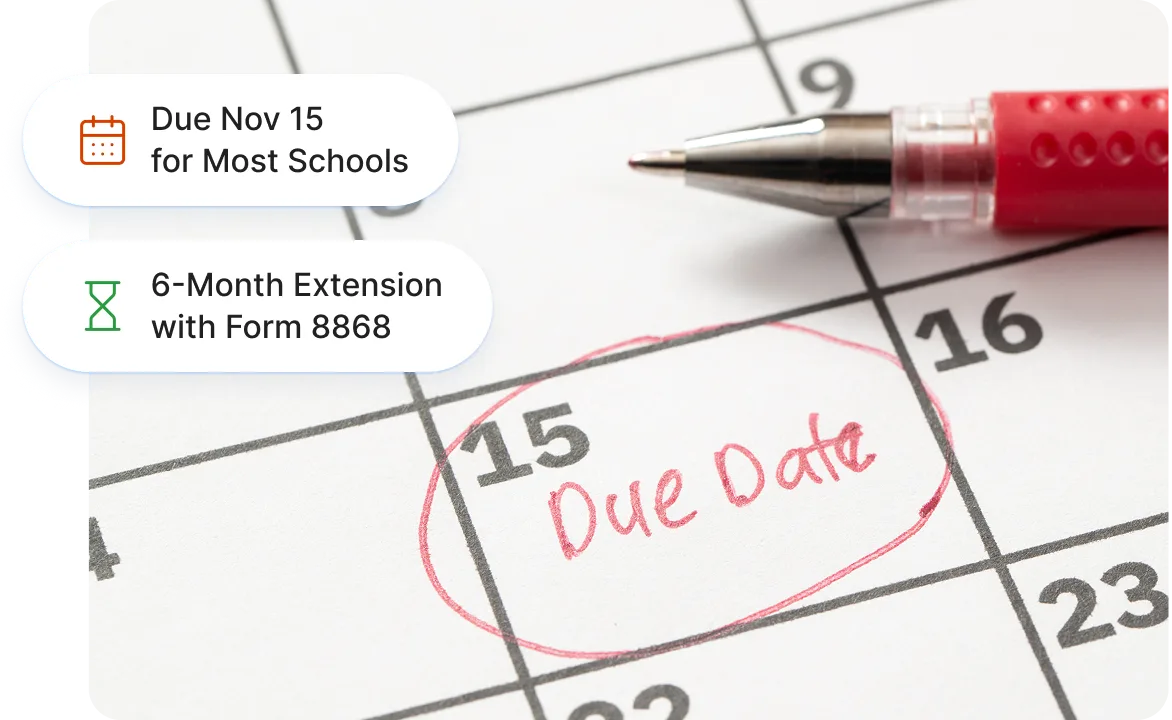
Form 990 is due on the 15th day of the 5th month after the end of the school's tax year.
- Schools on a calendar tax year file by May 15.
- Some schools run on a July 1 to June 30 fiscal year, so their return is due November 15.
Need more time? Form 8868 gives an automatic 6-month extension when it's filed by the original due date. Form 990-N can't be extended.
WHY TAX990
Meet Your School's 990 Filing Requirements
with
Tax990
Business managers, finance teams, and volunteer treasurers use Tax990 to file correctly, even in a first year on the job.
Interview or form-based
Answer plain-language questions, or enter figures straight into the form if your accountant prefers.
Built-in error checks
An internal audit catches mistakes before the return goes to the IRS.
Board and auditor review
Invite your head of school, board treasurer or CPA to review and approve the return, then e-sign Form 8453-TE.
Copy prior-year data
Carry last year's details forward, so a new business manager never starts from scratch.
Schedule E included
Schedule A, Schedule E and every other schedule your return needs are generated at no extra cost.
Multi-school filing
Networks, dioceses, and charter management organizations can manage every school's EIN from one account, with bulk upload.
PROTECTION & COMMITMENT
Support That Lasts Beyond Filing
The Tax990 Commitment
From first click to filing, and beyond,
we've got your school's back
-
 Complimentary extension requests if you need
more time -
 No-cost amendments in case anything needs to
be updated -
 Free retransmission if the IRS rejects
your return -
 Money-back guarantee so you can file
with confidence

$1M Tax Protection™ for 990 Forms
Tax990 partners with Protection Plus

Up to $1M Tax Protection™
Up to $1M in protection on your filed 990.

Expert IRS Notice Assistance
Expert help responding to IRS notices.
FAQs
Frequently Asked Questions
Most are, but in different ways. Public schools and school districts are government entities, so their income isn't taxed and they don't file Form 990. Private and charter schools organized as nonprofits are tax-exempt once the IRS recognizes them under section 501(c)(3), and they file a Form 990-series return each year to keep that status.
Generally no. A public school is part of a state or local government unit, and governmental units aren't required to file Form 990. Donations to a public school can still be deductible because it is a government entity. The school's PTA, booster club or education foundation is a separate 501(c)(3) organization with its own filing requirement.
It depends on how the charter school is set up. A charter school operated by a nonprofit corporation with its own 501(c)(3) status files Form 990, 990-EZ, or 990-N like any other private school, including Schedule E. A charter school run directly by a district or other government body generally does not file.
Not if the school is below college level and is affiliated with a church or operated by a religious order: the IRS lists these schools among organizations not required to file Form 990 or 990-EZ. They must still certify their racial nondiscrimination policy every year on Form 5578. Religious colleges and universities are not covered by this exception.
Schedule E is the Form 990 and 990-EZ schedule for schools. If your school checks the school box on Schedule A, you answer "Yes" on Form 990, Part IV, line 13 (or Form 990-EZ, Part VI, line 48) and attach Schedule E. It covers your racially nondiscriminatory policy, how you publicize it, and the records you keep. Tax990 includes it at no extra cost.
Yes. Every 501(c)(3) organization that operates a private school must certify each year. Schools that file Form 990 or 990-EZ do it on Schedule E. Schools that don't file either form, such as 990-N filers and church-affiliated schools, file Form 5578 by the same due date.
No. The IRS instructions for Form 1023-EZ say an organization seeking recognition as a school is not eligible to use it. Schools apply on the full Form 1023, filed electronically through Pay.gov.
Under the 2025 Form 990 instructions, a late return can draw a penalty of $25 per day, up to the lesser of $13,000 or 5% of the school's gross receipts. Schools with gross receipts over $1,309,500 face $130 per day, up to $65,000. Missing any required return for three consecutive years automatically revokes tax-exempt status.
Yes. Form 8868 requests an automatic 6-month extension for Form 990, 990-EZ or 990-T. It has to be filed on or before the original due date. Form 990-N has no extension.
Sometimes. Income from a trade or business that is regularly carried on and unrelated to the school's educational purpose, such as selling advertising in event programs, can be unrelated business income. Many common items are excluded, including most rent from real property and activities run almost entirely by unpaid volunteers. A school with $1,000 or more in gross unrelated business income files Form 990-T in addition to its regular return.
Yes. Form 990 and 990-EZ returns, including Schedule E, are open to public inspection, and a school must make its last three years of returns available on request. Names and addresses of donors listed on Schedule B are not disclosed.
Yes. Each school with its own EIN files its own return, but a network, diocese or charter management organization can prepare and track them all from a single Tax990 account.
Yes, if it has its own EIN and its own exemption. A school foundation, PTA, PTO or booster club files its own 990-series return, apart from the school's return. Tax990 can manage both in the same account.
ALL YOUR FILING REQUIREMENTS COVERED
Keep Your School in Good Standing
One account for your school and every foundation, PTA, or booster group connected to it. Guided,
IRS-authorized, and backed by $1M in
audit protection.
Nonprofit schools must file every year to keep their 501(c)(3) status.